- Commercial Greenhouse
- Film Greenhouse
- PC Greenhouse
- Glass Greenhouse
- Tunnel Greenhouse
- Scientific Research Greenhouse
- Vegetable Greenhouse
- Flower Greenhouse
- Multi-span Greenhouse
- Sawtooth Greenhouse
- Greenhouse Equipments
- Greenhouse Accessories
- Hot Dip Galvanized Pipe
- Irrigation System
- Hydroponics System
- Planting Tools
- Planting technology
Tel: +86 191 5068 3942
Fax:
Mobile: +86 191 5068 3942
Contact: Alina
E-mail: sales@cngreenhouses.com
SKYPE:

News Show
Greenhouse Fertilizer: Nutrient Roles and NPK Ratio Logic
Fertilizer is a set of supplies, each with its own job in the plant and its own moment in the season. Full and rational use of chemical fertilizers is proved to promote crop production and speed up agricultural development [1].
What Each Group of Nutrients Does
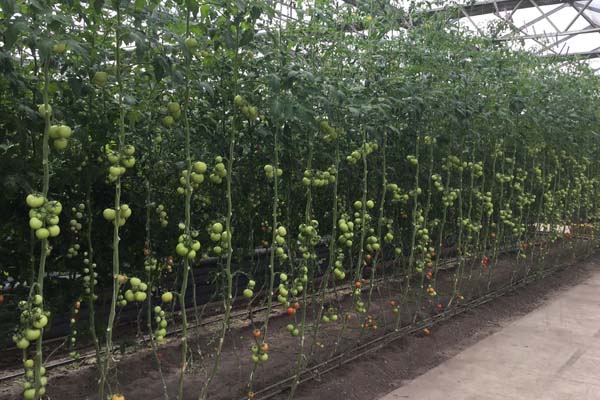
The three main nutrients carry most of the demand. Nitrogen builds leaf, stem, protein and chlorophyll; phosphorus drives root development, energy transfer and flower-bud and seed formation; potassium regulates water and stress tolerance and moves sugars into the harvested part. Calcium holds cell walls and growing tips, magnesium sits at the centre of chlorophyll and sulphur is bound into proteins, while iron and manganese serve photosynthesis, zinc growth-hormone synthesis, boron pollination, and copper and molybdenum nitrogen metabolism. A shortage is read rather than guessed: a symptom on the older leaves points to a mobile nutrient, one on the new growth to an immobile one.
For each tonne of rice, hybrid varieties absorb more than 27 kg of nitrogen, 12 kg of phosphorus pentoxide and 26 kg of potassium against conventional varieties. Every variety takes the same nutrients in the same amounts per unit of grain formed, so a high-yielding variety is in effect a high-fertilizer variety that takes up more and turns it into yield.
Why the NPK Ratio Shifts, and How to Check It
The balance a crop wants in June is not the balance it wanted in April. A young plant with a small root system is established by phosphorus and a little nitrogen; through the vegetative stage nitrogen leads while leaf area is built; as flowering and fruit set take over the balance turns towards potassium, which moves sugars into the fruit.
That is why fertilizer technology moved as it did: from a single nitrogen fertilizer and then phosphate, to nitrogen and phosphorus stabilised with potassium and on to NPK compounds, now towards efficient, complex and long-term oriented products with attention paid to trace elements [2-3]. The soil surveys of 1959 and 1980 put a great deal of manpower and material resource into detailed scientific analysis of soil nutrients, and extension workers used them for a simple rule: make up what the soil is missing, in the amount it is missing. Balanced fertilization and soil testing grew out of it, and a crop fertilization system suited to the conditions of the time was established.
A modern test reads pH, organic matter, available nitrogen, phosphorus and potassium and the salt level of the root zone, each of which changes the answer; tissue analysis shows what the plant has taken up. Rates, ratios and timings differ with the soil, the crop, the target yield and the climate, so the figure for a house comes from its own test and local agronomic advice.
The results have been large. In Lishu, grain yields of 1,500 to 3,000 kg per hectare before fertilizer rose to more than 11,250 kg per hectare; from 1998 to 2008 the county's nitrogen application rose from 115 to 200 kg per hectare and grain yield from 7.2 to 11.5 tonnes per hectare, easing rural heating and returning organic matter to the soil directly and through animal husbandry, and farmers' understanding of scientific application improved with it. The country farms 9% of the world's arable land, accounts for 25% of world agricultural production and feeds 22% of its population, and chemical fertilizer is estimated to contribute about 50% of grain yield.
Fertigation: Concentration and Frequency
Fertigation puts the nutrient into the irrigation water so it arrives in the root zone with the water the crop is already taking: the supply is split across the season instead of placed once and follows the root as it extends, saving labour. The hardware is a greenhouse irrigation system with filtration at the head, an injector and monitoring of the water's strength, and the drip laterals and emitters that deliver it.
Strength is judged from the crop and the stage before it is judged on a chart: seedlings and young transplants tolerate a strong solution least and established fruiting crops most. The working strength should come from the water analysis and local agronomic advice, and the check is the plant: scorched leaf margins, a stalled crop, a rising root-zone reading.
Frequency follows the water rather than the calendar, little and often: more events with a smaller volume in hot, bright weather, fewer when it is cool and dull. A clear-water flush at the end of a feeding pass keeps nutrient from sitting in the emitters.
Over-Feeding, Salt Build-up and What Fertilizer Leaves Behind
Feeding past the demand does not disappear; it accumulates. Unused salts stay in the root zone, raise its concentration and make water harder to take up, so the most heavily fed crop can show drought symptoms, midday wilting and scorched leaf margins, while the bed is wet. It is worse under cover, where rain cannot wash the root zone.
Leaching is the remedy: clear water is used deliberately to move salt out of the root zone, and the drainage takes it away. How much that takes depends on the texture and structure of the soil and how well it drains, so the amount belongs with the soil test.
Not everything applied is lost. Each time fertilizer goes on, a considerable part stays in the soil after the crop is taken off — about 30% of the nitrogen, 80% of the phosphorus and 50% of the potassium — and while some continues to leave by various routes, most remains available to the following crops. That is the after-effect of chemical fertilizer, and after years of rational use the after-effects superimpose: available nutrients rise, yield goes up and the fertility of the arable land is held.
Lishu illustrates both sides. The Agriculture Technology Promotion Centre's located monitoring in 2008 found 0-20 cm topsoil averaging 2.14% organic matter, up 0.54 points on the 1.60% of the second soil survey; total nitrogen 0.1155% against 0.1070%; total phosphorus 0.048% against 0.069%; total potassium 2.25% against 2.29%. Available nitrogen, phosphorus and potassium trended upward, and available phosphorus improved two to three times over the second survey. Behind part of that: the higher the yield, the more stubble and organic matter are left in the soil and the more vigorous the microbial activity [4].
Our factory has built greenhouses for above 35 years. Send the house type, the covering, the crop and the target and we will advise on the irrigation and feeding arrangement; the planting technology notes carry the same conditions into the crop, the soil preparation and sowing guide comes before the first feeding, and ventilation control the humidity that governs transpiration. Call +86 191 5068 3942, write to sales@cngreenhouses.com, or read independent growing-practice material from NGMA and HortWeek.
Frequently Asked Questions
Q: Why does the NPK ratio change during the season?
The job changes: phosphorus and a little nitrogen establish the young plant, nitrogen leads while leaf area is built, and potassium as sugars move into the fruit.
The job changes: phosphorus and a little nitrogen establish the young plant, nitrogen leads while leaf area is built, and potassium as sugars move into the fruit.
Q: How strong should a fertigation solution be?
Strong enough for the crop and the stage and no more; take the strength from the water analysis and local advice.
Strong enough for the crop and the stage and no more; take the strength from the water analysis and local advice.
Q: How often should the crop be fed through the irrigation line?
Little and often, in step with the water: smaller volumes and more events in hot bright weather, fewer when it is cool and dull.
Little and often, in step with the water: smaller volumes and more events in hot bright weather, fewer when it is cool and dull.
Q: What are the signs of over-feeding?
Salts build up in the root zone and water becomes harder to take up, so the plant wilts at midday and scorches at the leaf margins while the bed is wet.
Salts build up in the root zone and water becomes harder to take up, so the plant wilts at midday and scorches at the leaf margins while the bed is wet.
Q: How is a salt build-up corrected?
By leaching: clear water is passed through the root zone into the drainage, and the amount depends on the soil and how well it drains.
By leaching: clear water is passed through the root zone into the drainage, and the amount depends on the soil and how well it drains.
Q: Does fertilizer leave anything behind for the next crop?
Yes: about 30% of the nitrogen, 80% of the phosphorus and 50% of the potassium remain after harvest, and most of it is available to the following crops.
Yes: about 30% of the nitrogen, 80% of the phosphorus and 50% of the potassium remain after harvest, and most of it is available to the following crops.
 Deutsch
 Español
 Français
 Italiano
 Português
 日本の
日本の
 한국어
한국어
 العربية
 български
 hrvatski
 česky
česky
 Dansk
Dansk
 Nederlands
 suomi
suomi
 Ελληνικά
 हिन्दी
 norsk
norsk
 Polski
 Română
 русский
 Svenska